
Quick Summary
Proper packaging helps protect your parcel during delivery. Choose packaging based on the weight, shape, size, value, and fragility of your items. Use suitable internal packaging to cushion and secure the contents, and strong external packaging to protect the parcel. For fragile items, use the box-in-box method. Finally, seal your parcel securely and ensure the Air Waybill (AWB) or consignment note is properly attached and visible.
We'll Cover:
How do I choose the right packaging for my parcel?
Choosing the right packaging is important to protect your items during delivery. Consider the following factors before packing your parcel:
Weight, Shape and Size
The box or packaging should be strong enough to hold the weight of the items being shipped. Odd-shaped or rounded items may require additional protection.
Value of Contents
High-value goods may require extra cushioning and protection to reduce the risk of damage during transit.
Fragility
Fragile items require extra cushioning and may need a special handling label such as "Fragile". You can find the available labels here.
Regulations
Some regulated items may require special packaging to be eligible for delivery. Items classified as prohibited or restricted are not allowed for delivery via EasyParcel. Refer here for more information.
What is the difference between internal and external packaging?
Proper internal and external packaging helps protect your parcel throughout the delivery process. All items should meet the packaging requirements of the courier. Incorrectly packaged items or parcels containing dangerous or prohibited materials may be refused and returned to the sender.
1. Internal Packaging
Internal packaging is used as cushioning to:
- Prevent damage from shocks, vibrations, impacts, and pressure during transit
- Prevent items within a parcel from touching each other
- Eliminate movement of the parcel contents
- Provide clearance between the items and the external packaging
Common packaging materials include bubble wrap, airbags, cardboard, and foam peanuts or pellets. Use suitable cushioning and void-fill materials to secure your items and provide additional protection.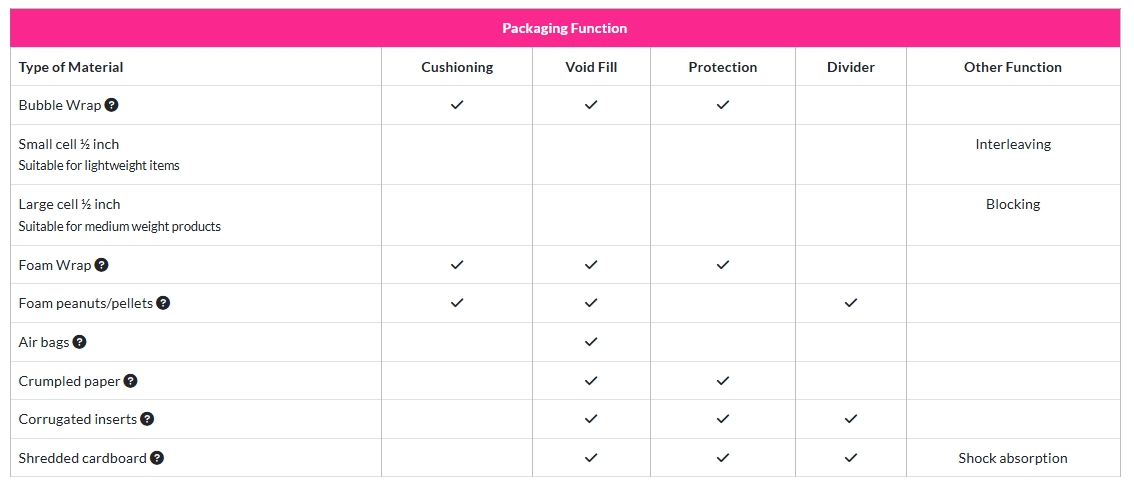
2. External Packaging
Use strong external packaging to protect the contents of your parcel.
- Use high-quality corrugated cardboard boxes.
- Double-wall or tri-wall boxes are recommended for fragile or heavy items.
- Choose a box that fits the items properly. Under-filled boxes may collapse, while over-filled boxes may burst.
- Make sure there is enough space for suitable internal packaging.
3. Packing Methods and Techniques
Follow these basic packing principles:
- Fill empty spaces with suitable void-fill materials such as foam peanuts, pellets, or airbags to prevent items from moving during transit.
- Place items in the centre of the box with at least 6 cm of separation from the external walls or corners.
- When shipping multiple items in one parcel, wrap each item individually and separate them with corrugated inserts or other divider materials.
- For odd-shaped or irregular items, wrap and secure sharp edges or protrusions.
- Do not strap multiple boxes together.
4. How to Pack
Single-Box Method
The single-box method is suitable for non-fragile items.
- Prepare a new, high-quality single-wall or double-wall box.
- Wrap the item with suitable cushioning material for additional protection.
- If shipping multiple items in one box, wrap each item individually and keep them properly separated.
- Place the items centrally with at least 6 cm of separation from the external walls or corners.
- Fill empty spaces with suitable void-fill materials to prevent movement during transit.

Learn more about the Single-Box Method.
Box-in-Box Method
The box-in-box method is suitable for fragile items.
- Prepare an outer box and an inner box.
- You can use the original manufacturer's packaging as the inner box or pack the item using the single-box method.
- The outer box should be at least 14 cm longer, wider, and deeper than the inner box.
- Place the inner box centrally with at least 6 cm of separation from the external walls or corners.
- Fill the empty space with suitable void-fill materials to prevent the inner box from moving during transit.

Learn more about the Box-in-Box Method.
How do I properly seal and label my parcel for successful delivery?
Proper sealing helps prevent your parcel from opening during transit, while correct labelling ensures the courier can identify and process your shipment correctly.
Sealing
Use suitable adhesive tape and the correct sealing method to secure your parcel.
Recommended tapes:
- Polypropylene tape (brown plastic tape)
- Vinyl adhesive tape (electrical tape)
- Fiber-reinforced paper tape (duct tape)
Avoid using:
- Kraft paper tape
- Cellophane tape
- Masking tape
- String
 H-Taping Method
For additional security:
- Apply 1 strip of tape along the centre seam.
- Apply 2 strips of tape across both edges of the parcel.
- Apply additional tape for heavier shipments.
 Labelling
Always use a clear and accurate Air Waybill (AWB) or consignment note with complete shipment details.
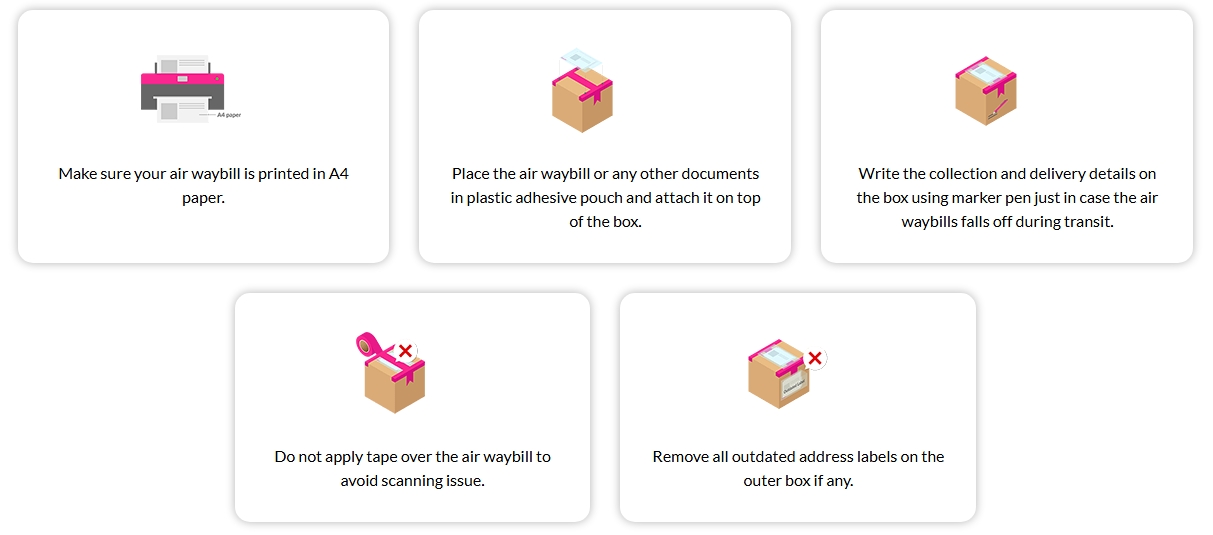
- Print the AWB on A4 paper.
- Place the AWB or other required documents in a plastic adhesive pouch and attach it to the top of the box.
- Write the collection and delivery details on the box using a marker pen in case the AWB becomes detached during transit.
- Do not apply tape over the AWB, as this may cause scanning issues.
- Remove any outdated address labels from the outer box.
- For international shipments, make sure all required documentation and shipment information are completed accurately to help avoid delays or additional charges.
Special Handling Labels
Special handling labels can help notify the courier how your parcel should be handled. Available labels include:
- Fragile, Handle With Care — indicates that the parcel contains fragile items and should be handled carefully.
- This Way Up — indicates the preferred orientation of the parcel.
- Keep Dry — indicates that the parcel should be protected from excessive humidity and kept dry.

You can view the available special handling labels here.