
Quick Summary
Chargeable weight is the weight couriers use to determine shipping costs. It may be based on the parcel's actual weight or volumetric weight, depending on which is higher.
Volumetric weight is calculated using the parcel's dimensions. The formula may vary depending on the courier, such as:
(Length × Width × Height) ÷ 5000
or
(Length × Width × Height) ÷ 6000
You can use EasyParcel's Volumetric Calculator to calculate your parcel's volumetric weight. The final volumetric weight is confirmed after you select a courier.
We'll Cover:
What is Chargeable Weight?
Chargeable weight, also known as billable weight, is the weight used by couriers to determine shipping costs.
It may differ from the actual weight of your parcel because couriers may consider both the parcel's actual weight and the space it occupies during transportation.
Generally, the chargeable weight is the higher of the actual weight and volumetric weight.
How to Calculate Chargeable Weight?
To calculate chargeable weight, you need to compare the parcel's actual weight with its volumetric weight.
Calculate the Volumetric Weight
Volumetric weight is calculated based on the length, width, and height of your parcel. The calculation method may vary depending on the courier.
Common formulas include:
(Length × Width × Height) ÷ 5000
or
(Length × Width × Height) ÷ 6000
You can use our Volumetric Calculator to calculate the volumetric weight more easily.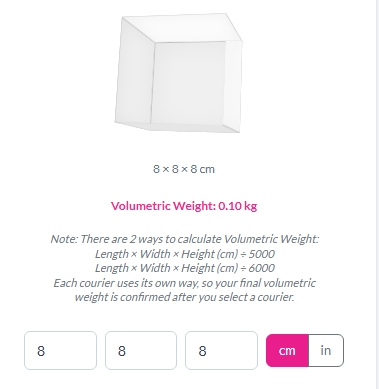
For example, if your parcel measures 8 × 8 × 8 cm, the volumetric calculator displays a volumetric weight of 0.10 kg. The calculator also notes that each courier may use a different calculation method. The final volumetric weight is confirmed after you select a courier.
Compare Actual Weight and Volumetric Weight
Once you have both values, compare the actual weight with the volumetric weight. For example:
- Actual weight: 5 kg
- Volumetric weight: 2.4 kg
- Chargeable weight: 5 kg
Since the actual weight is higher than the volumetric weight, the chargeable weight is 5 kg.
If the volumetric weight is higher, the parcel may be charged based on its volumetric weight instead.
What is the Difference Between Chargeable Weight and Actual Weight?
Actual weight is the physical weight of your parcel when measured on a weighing scale.
Volumetric weight is calculated based on the amount of space your parcel occupies.
Chargeable weight is the weight used by the courier to determine your shipping cost and may be based on whichever is higher between the actual and volumetric weight.
For example, a large parcel containing lightweight items may have a low actual weight but a higher volumetric weight because it takes up more space during transportation.
Understanding the difference between these weights can help you estimate your shipping costs more accurately.
How Can I Optimize My Chargeable Weight?
To optimize your chargeable weight, choose packaging that fits your items properly and avoid unnecessary empty space. You can:
- Use a box that is suitable for the size of your items.
- Avoid oversized packaging where possible.
- Fill unnecessary gaps with suitable cushioning materials.
- Make sure your parcel is securely packed without adding unnecessary packaging.
You can refer to our packaging guide for more tips on choosing suitable packaging and packing your parcel securely.